
‘I wouldn’t have this life without my disability’
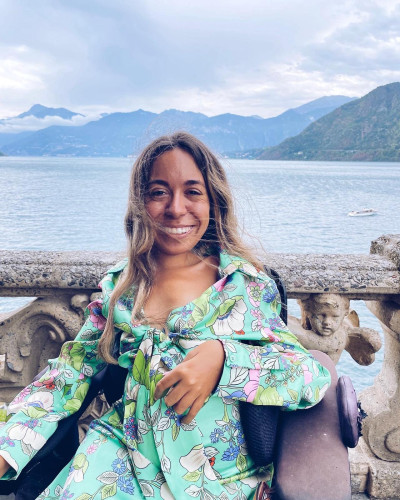
Beatriz Bastiao is a young woman with a physical disability who currently lives in Geneva, Switzerland, and works with the International Labour Organisation. Originally, she is from Portugal. How she got to work in Geneva and how she experiences her life with a disability there and in Portugal she describes in this interview.
Could you tell about your background: when and where were you born, do you have your disability since your birth, what is your disability exactly?
I am Beatriz, a young woman with a disability who is passionate about disability and women’s rights, and who works on international development. I am 25 years old. I was born in the summer of 2000 in Aveiro, Portugal, where I grew up and completed my education, always alongside my family and friends. Aveiro is a coastal city in the north of Portugal, known as the Portuguese Venice thanks to the beautiful canals that run across the city. I was born with a rare disease called spinal muscular atrophy which, in simple terms, means that the connection between my nerves and my muscles is flawed and therefore my body can’t develop as much muscle strength as a human body usually does. The symptoms started to manifest themselves early on, I hesitated to crawl and move around as a baby. My parents decided to speak with my paediatrician, who referred them to a neurologist. I received my diagnosis when I was 18 months old. I am a full time powered-wheelchair user, which I have used ever since I was old enough to drive it without hurting myself and others, at the age of four. I currently live independently with the support of my father, who is currently my main caregiver.
How do you cope with your disability?
The short answer is: I am perfectly okay and happy with my disability. I love myself and my life. Despite not always loving my disability, I love the person I am because of it.
The longer answer is not that simple. I don’t think that there’s a magic moment when you finally accept your disability and become happy overnight. It’s a process. I had an incredibly happy childhood, mostly thanks to my family and outstanding support system. I was privileged enough to have parents who provided everything I have ever needed, who loved me unconditionally, who always went out of their way to ensure I knew that I deserved a place wherever I wanted in this world. They never allowed me to miss any opportunity to experience joy. Thanks to this, I grew up to be a positive, resilient child, who always knew love.
Going into adolescence is hard for every child, particularly for every girl. We start to develop a new personality, we find out our preferences and our tastes, we start finding ourselves. And we have to do all of this socially, with other people going through the same, when we are at our most vulnerable. This is difficult enough for every young girl, but doing it with a visible disability is a heightened challenge. I’d say adolescence is when our prejudices and biases are at its peak, mostly due to the strong need for validation from other adolescents. So, having to find myself while knowing that I wasn’t looked at in the same way as my peers required a lot of courage. It required me telling myself time and time again that I was valid and worthy despite the world telling me otherwise (I know now it wasn’t 'the world', my family and friends loved me, but the least important voices are often the ones we listen to the most). My self-love got me through so much, but it didn’t come out undamaged.
Even now, as a confident young woman, I don’t always love my disability, I don’t always love my atrophied body, I don’t always love how my disability inevitably shapes my social interactions and the connections I build with people. But, more often than not, I do. I love the person I am because of my disability, it unquestionably made me a better person. I love how my body sustains itself, how it adapts constantly to keep me alive, how it never gave up on me and how it keeps on being the vessel through which I get to experience this beautiful world. I also love that my disability allowed me to create bonds with people that I wouldn’t create otherwise like experiencing kindness from strangers and having an unbreakable bond with my dad, for example. If this reads slightly incoherent, it’s because it is. Accepting your disability is a journey with many twists, turns and setbacks. My feelings about myself are antithetical sometimes. But I’m honestly so happy with my life. I wouldn’t have this life without my disability.
How did you get in Geneva and when?
I moved to Geneva in 2024 for an internship at the ILO, the United Nations agency for the world of work. To explain how I ended up in Geneva, I have to start way before.
Ever since I remembered, I have wanted to work in international development. International relations and multilateralism fascinated me and I have always wanted to be 'in the room where it happens'. I wanted to contribute to a better world for other people, I wanted to give back to the world from which I received so much love and happiness. Nonetheless, I thought that those doors were closed for me. I didn’t have the right degree, I didn’t know the right people, I didn’t have the possibility to move to a different country on my own. I think it was precisely I thought that it could never happen that I just kept applying to internships I dreamed of. I didn’t have to think about how I would pull it off, because it would never happen. Until one day, in March 2023, I was offered an internship opportunity at an agency of the European Union and my first thought was 'how am I going to say no?'. I couldn’t realistically move to another country when I needed so much support in my everyday life. But my parents didn’t let me say no. Like she always does, my mom said 'how can we make this happen'. And like he always does, my dad said 'I’ll do whatever it takes to make this happen'.
I moved to Vienna, Austria, in March 2023 for a 6-month internship at the EU Fundamental Rights Agency. My dad took leave from work and joined me. This is when my career started. After the experience in Vienna, I became undoubtedly sure that I could not do anything else with my life. This is what was meant for me. When searching for new opportunities to apply to, I stumbled upon an internship vacancy within the ILO to work on the access to decent work for persons with disabilities. It seemed like it was made for me. One of the most humbling and thankful moments of my life was receiving this internship offer. I moved to Geneva in March 2024 for the 6-month internship within the ILO, where I still work until this day. Living in the hub of multilateral cooperation in Europe and being able to attend meetings in UN Headquarters still feels unreal to me. I am finally in the room where it happens.
Do you miss Portugal?
I do miss Portugal. I miss the familiarity and the comfort of being home. I miss my family, my friends, my dog. But I am lucky I can go back when homesickness hits harder. However, I wouldn’t want to go back permanently. What’s for me is not there. I know that the career I dream of can’t be achieved in Portugal. I love going back home, but I also love having a return ticket to Geneva.
Are you able to compare the situation of people with a disability in Switzerland and Portugal? Which country takes better care of them and how does one notice that?
I don’t think I am in a position to compare the life of persons with disabilities in Portugal and in Switzerland. This is because I am not a Swiss citizen nor do I have the right to access the Swiss financial, social security or health systems as a UN staff member. I retain the right to benefit from the social security and health systems in Portugal and therefore do not know enough to have an opinion on the Swiss support systems for persons with disabilities. My only saying is that I see much more people with visible disabilities out on the street in Switzerland than I do in Portugal. This is incredibly subjective and not an argument any credible researcher would use.
How is life for people with a disability in Geneva in general (accessibility, financial, social life)?
Accessibility is one of the few things I can credibly speak on. Of course, I speak as a wheelchair user and can’t say much on other accessibility needs. Especially compared to Portugal, Switzerland is incredibly accessible. There are many more accessible public spaces in Switzerland (although not all of them are). Public transport also follows pretty high accessibility standards. In Switzerland, you can go almost anywhere by train. Most trains and stations are step-free. When they are not, which is rare, assistance is provided or alternative transportation is granted. In short, the best way I can describe accessibility in Switzerland is as follows: when I don’t know if a certain place or service in Portugal is accessible, I can safely assume it is not. In Switzerland, I can safely assume that it is. I am right 90% of times.
In Switzerland, I also feel way less stares from strangers. I think disability is more normalised here, while in Portugal going out in the streets can still make me feel like I am a zoo animal sometimes. One great difficulty I had, nonetheless, was finding affordable accessible housing in Geneva. The housing market in Geneva is stretched to its limit and most of the available housing is in old inaccessible buildings. Accessible housing is restricted to newer modern buildings of which the price is not really budget friendly, to say the least. Nonetheless, I never looked for housing in Portugal and therefore can’t compare the two countries.
Could you describe what your function within ILO is about exactly?
Currently, I am a Gender Equality and Disability Inclusion Officer at the ILO. I work within the 'Conditions of Work and Equality' Department, and my current focus is on two projects. One is on promoting gender equality and work-life balance policies in Portugal. Another one, titled ILO Global Business and Disability Network, is a network of multinational enterprises committed to improve disability inclusion within their activities. Although I have changed roles twice already, I’ve been fortunate to keep on working on equality issues since I have joined the ILO. I couldn’t be happier to work on a topic I’m so passionate about.
Since when have you been working with ILO?
I joined the ILO one year and a half ago, in March 2024, as an intern working on disability policy and programmes. After the 6-month internship ended, I stayed on board in a junior role at the Human Resources Development Department where I was coordinating ILO’s internship programme for persons with disabilities. In August 2025, I started with the aforementioned project. During my time at the ILO I worked with the most outstanding team of disability, gender and human resources experts, extraordinary people. I learned much more than I could have dreamed of.
Is inclusion of people with a disability at the workplace an important matter for ILO?
Access to decent work for persons with disabilities is a core issue for the ILO. In fact the ILO was one of the first international organisations focusing on disability with the approval of Convention 159 on Vocational Rehabilitation and Employment of Disabled Persons in 1983. Of course, the convention is a product of its time and, as you will notice if you read it, does not necessarily follow the social model of disability. Nevertheless, it was the first internationally accepted document stating that persons with disabilities have the right to access decent work. Since then, the ILO has made huge progress on disability. From developing research on disability and employment to implementing programmes across the world aiming to benefit persons with disabilities directly. And to engage unions and employers worldwide in the importance of disability inclusion.
How does ILO try to realise this? Can it impose measures on the members or only give advice?
The ILO has two main ways of delivering on its mandate. First, through the development and implementation of International Labour Standards (ILS), i.e., conventions and recommendations. Second, through the implementation of programmes and projects. Like all other UN bodies the ILO exists because governments, employers and workers want it to exist. This means that the ILO works on the topics they want us to work on. We can’t impose anything on our members. On the contrary, we mostly respond to their requests. Fortunately, our members have always been supportive of disability inclusion issues and keep on requesting the ILO to work on the topic. For that reason the ILO has developed ILS that cover disability inclusion issues, ratified by more than 100 countries, and has been implementing programmes and projects at the request of our members. Programmes and projects that have contributed to fulfilling the rights of thousands of persons with disabilities worldwide.
Which topics as far as inclusion at the workplace is concerned is ILO currently working on?
Access to decent work for persons with disabilities is a complex challenge. The ILO focuses on the world of work exclusively - because that is what we are mandated to do - but we recognise that all human rights are interconnected. Access to decent work can’t be realised if access to education, health, civic participation and independent living are not realised too. Having said this, the ILO focuses on different topics concerning inclusion of persons with disabilities in the world of work: recruitment, career development, reasonable accommodation, discrimination/violence/harassment at the workplace, occupational segregation, vocational training, access to universal social protection. The ILO has also been working intensively on the care economy and access to decent work for care and support workers. Although this is not exclusively focused on persons with disabilities, guaranteeing access to decent work for care workers worldwide means improving the quality of care and support services many persons with disabilities rely on.
Copyright text: Johan Peters, 24/09/2025 - ...
Copyright photo: Beatriz Bastiao/Johan Peters